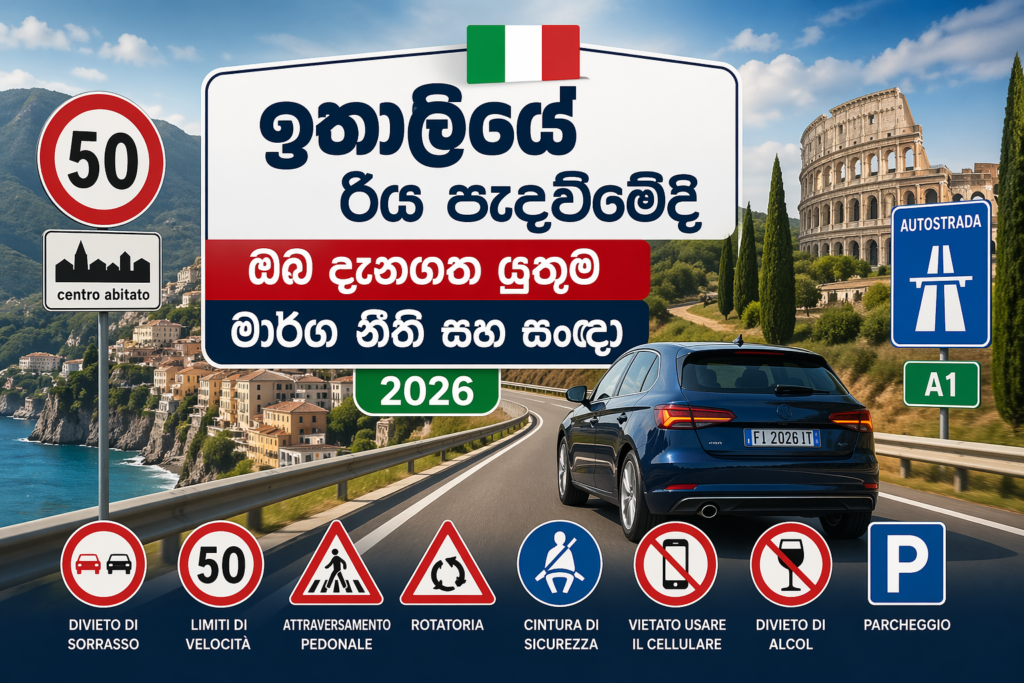
Navigating Italian Roads: The Ultimate Expat's Guide to Licenses, Rules, and Car Maintenance
For many expatriates, international students, and foreign professionals building a new life in Italy, the dream of cruising down sun-drenched Tuscan hills or navigating the historic, bustling streets of the Lombardy region is a powerful one. Owning a vehicle in Italy opens up a world of unparalleled independence, allowing you to explore hidden provincial towns that the intricate train networks simply do not reach. However, behind the romanticized vision of the Italian road trip lies a highly structured, fiercely regulated, and often confusing bureaucratic reality.
Transitioning from being a pedestrian to a licensed driver in Italy requires much more than simply buying a car. It involves a deep understanding of complex licensing laws, navigating the famously intricate Italian driving culture, adhering to strict municipal traffic restrictions, and maintaining your vehicle according to rigorous seasonal standards. Whether you are living near the industrial hubs of Milan or the quieter suburbs like Rho and Passirana, understanding these elements is entirely essential. This comprehensive guide will walk you through the entire journey: from finally converting your foreign driver's license, to avoiding exorbitant automated fines, and understanding what your local tire technician expects from you.
1. The Great Hurdle: Converting Your Driver's License
Perhaps the most significant and widely discussed hurdle for any non-EU resident is obtaining a valid Italian driver's license, officially known as La Patente di Guida. If you are a resident of Italy, you are generally allowed to drive using your valid foreign driver's license (accompanied by an official International Driving Permit or a sworn Italian translation) for a maximum period of one year from the exact date you register your official residency (iscrizione anagrafica).
Once that first year expires, your foreign license is no longer legally recognized on Italian soil. Historically, many foreign nationals faced the daunting, expensive, and time-consuming task of completely retaking both the rigorous theoretical and practical driving exams entirely in the Italian language. However, the legal landscape is constantly evolving through bilateral agreements between Italy and various non-EU nations.
For example, landmark legislative changes that officially took effect around April 2026 have finally paved the way for citizens of specific nations—including newly formalized agreements for Sri Lankan nationals—to directly convert their home country's driving licenses into Italian ones without undergoing the agonizing examination process again. This is a monumental shift that saves thousands of Euros and months of studying.
The Conversion Process Explained
Initiating the conversion process (Conversione della Patente) requires a systematic approach and interaction with the Ufficio della Motorizzazione Civile (the Department of Motor Vehicles). Here is what the process generally involves:
- Official Translation & Authentication: Your original license must be valid and accurately translated into Italian. This translation must be sworn and certified, typically handled by the consulate of your home country in Italy or a legally recognized translator at the local court.
- Medical Certification (Certificato Medico): You cannot simply swap the card. You must undergo a brief medical examination conducted by an authorized doctor (often found at local driving schools or the ASL). This check primarily tests your visual acuity, hearing, and general physical fitness to operate a vehicle safely.
- Documentation Compilation: You will need your official residency certificate (Certificato di Residenza), your valid Permesso di Soggiorno (Residence Permit), your Codice Fiscale, high-quality passport-sized photographs, and the completed TT2112 application form.
- Submission: While you can submit these documents directly to the Motorizzazione, many expats choose to use an Agenzia di Pratiche Auto (an automotive administrative agency) or an Autoscuola (driving school). They charge a handling fee but save you from enduring endless bureaucratic queues and language barriers.
Important Legal Warning
If you choose to drive with an expired foreign license or fail to convert it after one year of residency, you are legally considered to be driving without a valid license. The penalties are severe, including fines ranging from €150 to over €1,000, the immediate confiscation of your vehicle, and catastrophic implications for your auto insurance in the event of an accident.
2. Surviving Italian Roads: ZTLs, Autovelox, and Culture
Once you are legally behind the wheel, you must rapidly adapt to the Italian driving ecosystem. Italian drivers are often stereotyped as aggressive, but a more accurate description is that they are highly decisive and assertive. Hesitation on a busy roundabout will cause frustration. You must drive with confidence while remaining hyper-aware of your surroundings.
The Dreaded ZTL (Zona a Traffico Limitato)
The single biggest trap for expat drivers is the ZTL. Almost every historical city center in Italy—from Milan to Florence to tiny provincial villages—has a Restricted Traffic Zone. These zones are designed to reduce pollution and protect ancient architecture. They are monitored by highly sensitive automated cameras. If you drive past a sign displaying a red circle on a white background without the proper municipal permit, a camera will snap your license plate, and a fine (ranging from €80 to €300) will be mailed to your registered address. Never rely blindly on GPS navigation apps like Google Maps, as they often route you directly through active ZTLs.
Speed Enforcement: Autovelox and Tutor Systems
Do not be fooled by the fast-paced driving style on the highways; speed limits are strictly enforced through automated systems. The Autovelox are stationary speed cameras housed in orange or blue boxes along provincial roads. More sophisticated is the Sistema Tutor used on the Autostrada (toll highways). The Tutor system does not just measure your speed at a single point; it records the exact time you pass point A and point B, calculating your average speed over a stretch of 10 to 30 kilometers. If your average speed exceeds the 130 km/h limit, a ticket is automatically generated.
3. Essential Car Maintenance: The Law of the Tires
Vehicle maintenance in Italy isn't just a matter of ensuring your car runs smoothly; it is heavily dictated by strict federal laws designed to maximize road safety across drastically changing seasons. For an expat, building a good relationship with a local mechanic or a specialized tire technician (known as a Gommista) is just as important as finding a good doctor.
One of the most critical, legally binding aspects of car ownership in Italy revolves around your tires. The Italian climate shifts dramatically, and navigating varying terrains—from the slick, rain-soaked cobblestones (pavese) of historic centers to the high-speed stretches of the Autostrada—demands absolute optimal tire performance.
The Winter Tire Law (L’obbligo delle Gomme Invernali)
As a driver, you must become intimately familiar with the seasonal tire changeover laws. By national law, typically running from November 15th to April 15th (though specific regional ordinances can extend this), vehicles traveling on designated provincial and highway roads must either be equipped with certified winter tires or carry approved snow chains onboard at all times. Winter tires must be explicitly marked with the "M+S" (Mud and Snow) designation, ideally accompanied by the three-peak mountain snowflake symbol.
Failing to comply with this law not only compromises your safety in icy conditions but will result in hefty fines if you are stopped by the Polizia Stradale (Highway Police). During the weeks leading up to November 15th and April 15th, local car centers and every Gommista in towns like Rho and Milan are booked solid for weeks. It is an annual ritual where thousands of drivers swap their summer sets for winter sets.
What Your "Gommista" Looks For
When you visit a professional car center for your seasonal swap, the technician isn't just changing the rubber. They evaluate the tread depth (battistrada), ensuring it is legally above the 1.6mm absolute minimum, though replacing them at 3mm is highly recommended for safety. Furthermore, they perform precision wheel balancing (equilibratura) and alignment (convergenza). Proper alignment is absolutely crucial in Italy, given the intense wear and tear your suspension and tires endure from navigating pothole-ridden country roads and ancient city cobblestones.
4. Insurance and the "Bollo Auto"
Finally, no guide to Italian driving is complete without mentioning the bureaucratic costs of ownership. Car insurance (Assicurazione RCA - Responsabilità Civile Autoveicoli) is legally mandatory. Unlike some countries where insurance covers the driver, in Italy, the insurance policy is strictly tied to the vehicle itself. Because you are converting a foreign license and will have zero "driving history" in the Italian system, you will unfortunately start at the most expensive risk class (Classe 14), making your initial premiums quite high.
Additionally, every vehicle owner must pay the Bollo Auto, which is an annual regional ownership tax. The cost of the Bollo is calculated based on the environmental class of your vehicle (Euro 4, Euro 5, Euro 6) and its engine power (kilowatts). Electric and hybrid vehicles often enjoy significant reductions or complete exemptions from this tax for the first few years, which is something to strongly consider when purchasing a car for city living.